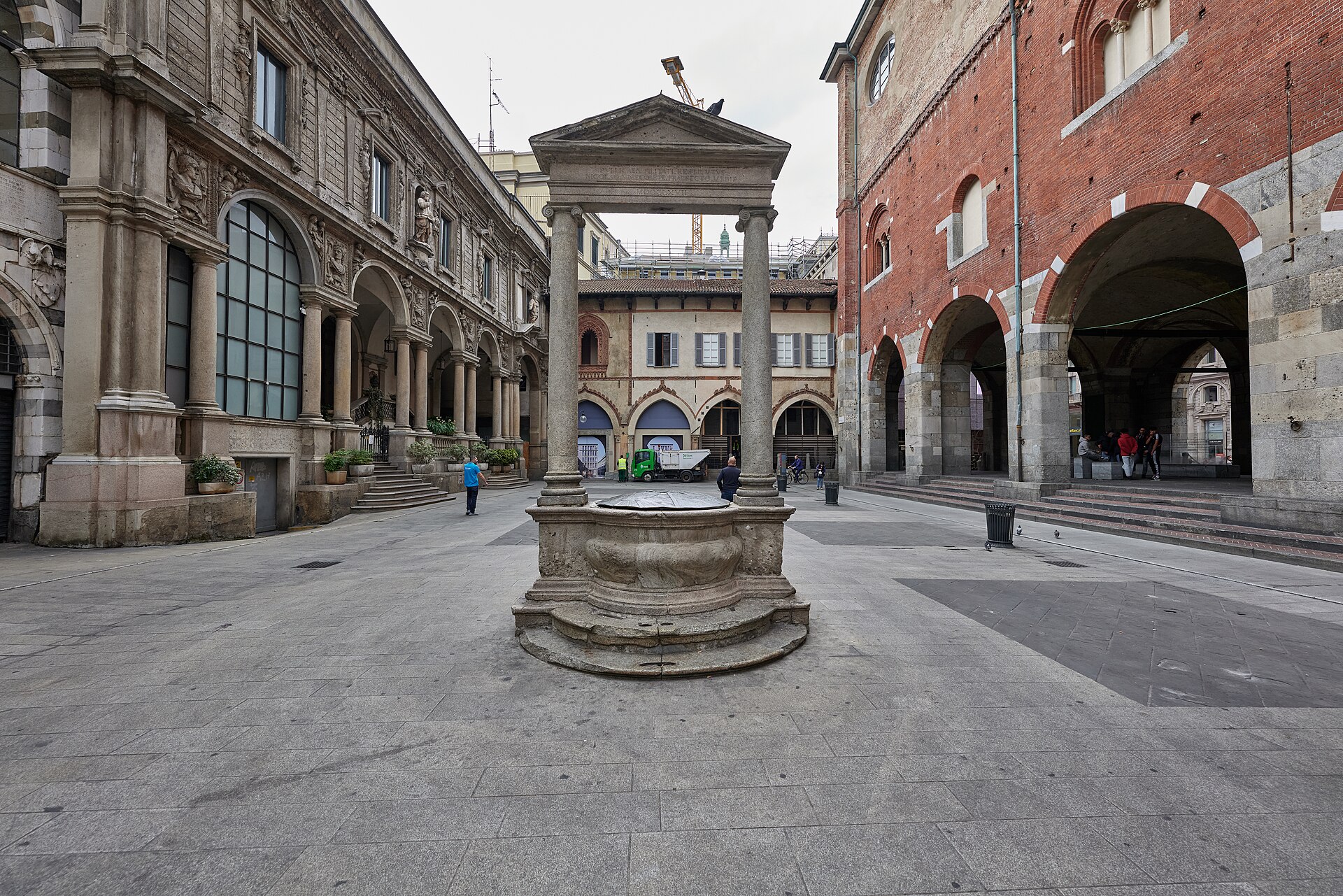
Piazza dei Mercanti is medieval Milan's surviving heart — a small, enclosed square one block north of the Duomo that served as the city's commercial and political centre from the 13th to the 18th century. The square is easy to miss (it's not on the main tourist axis, and the Duomo's gravitational pull draws visitors south rather than north), but it contains some of the oldest surviving buildings in central Milan and provides the only tangible sense of what the city looked like before the modern era erased most of its medieval fabric.
The Palazzo della Ragione, built in 1233 as the city's broletto (communal government building), is the square's centrepiece — a red-brick structure raised on arched porticoes that created a covered marketplace on the ground floor and a courtroom above. The building's balcony (the parlera, from the Italian 'to speak') was where government decrees were announced, and the carved relief of a sow (the scrofa semilanuta, a half-woolly pig that is one of Milan's oldest symbols) decorates one of the columns.
The Loggia degli Osii (1316), the Casa dei Panigarola (15th century), and the Scuole Palatine (1644) complete the square's ensemble, creating a miniature architectural history from Romanesque to Baroque in a space you can cross in 30 seconds. The square's acoustics have an unusual property — if two people stand in opposite corners and whisper into the wall, they can hear each other clearly across the diagonal. Whether this was designed (some claim it was created for merchants to conduct private transactions) or accidental, it's one of Milan's most delightful party tricks.
Verified Facts
The Palazzo della Ragione was built in 1233
The piazza served as Milan's civic and commercial centre for centuries
The scrofa semilanuta (half-woolly pig) is one of Milan's oldest symbols
The square has unusual acoustic properties allowing whispered communication across corners
Get walking directions
Via dei Mercanti, Centro Storico, Milan, 20123, Italy