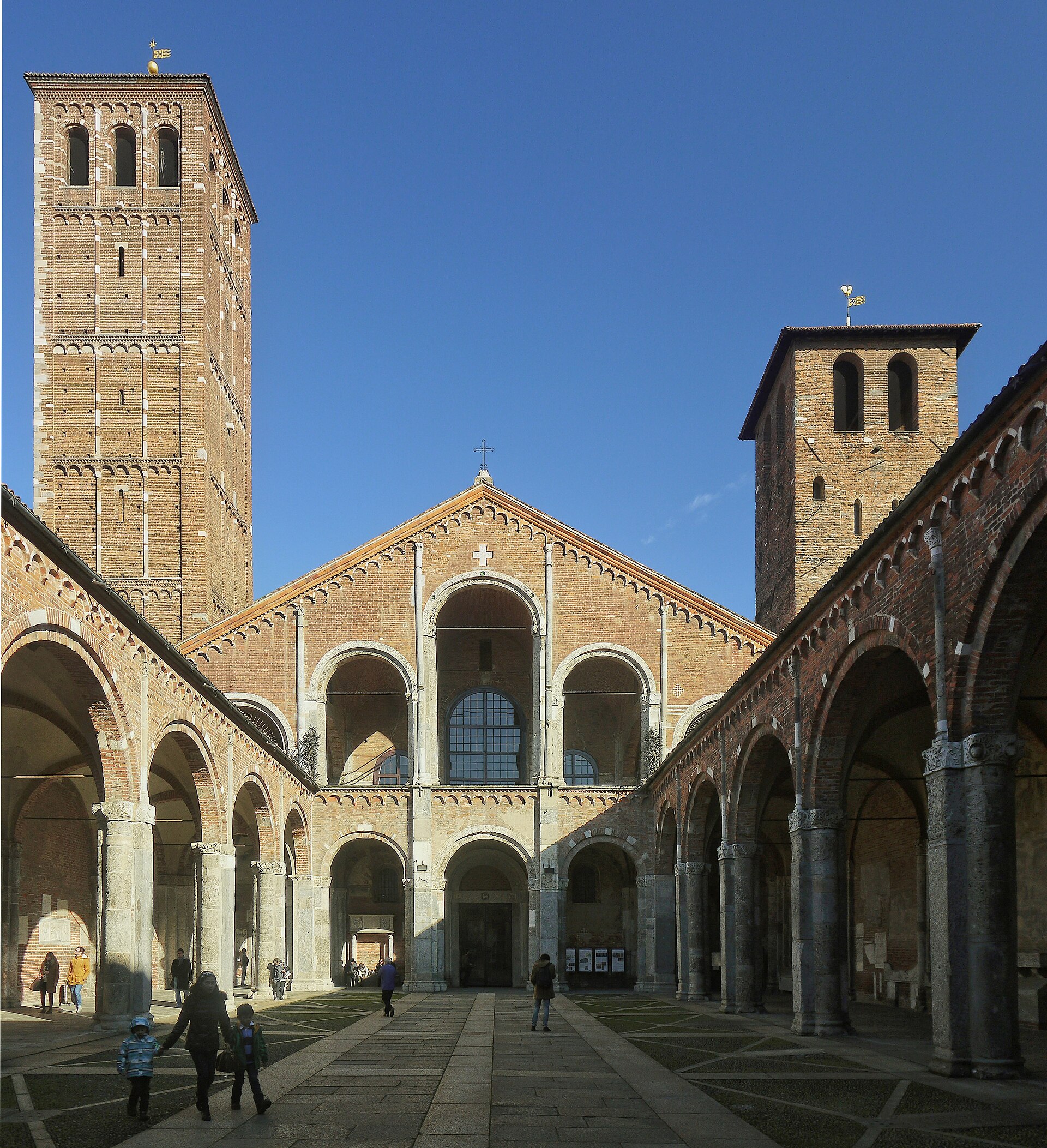
Sant'Ambrogio is Milan's most important church — older than the Duomo by nearly a millennium, founded in 379 AD by Saint Ambrose (Milan's patron saint and one of the four original Doctors of the Church), and rebuilt in its current Romanesque form in the 11th and 12th centuries. The basilica is the spiritual heart of Milan in a way that the Duomo, for all its scale, can never be — this is where Ambrose baptised Augustine, where Milanese emperors were crowned, and where the city's identity as a centre of Christianity was established.
The exterior is austere Romanesque — brick and stone, two mismatched bell towers (one from the 9th century, one from the 12th), and an atrium of arched porticoes that serves as a transition space between the street and the sacred interior. The interior is equally restrained: brick vaults, Romanesque columns with carved capitals, and a golden altar (the Paliotto di Sant'Ambrogio) from the 9th century that is one of the most important works of Carolingian goldsmith art in existence.
The crypt beneath the altar holds the remains of Saint Ambrose and the martyrs Gervasius and Protasius — three skeletons dressed in episcopal robes and displayed in a glass case, which is either a moving expression of medieval piety or deeply macabre depending on your sensibility. The basilica sees a fraction of the Duomo's tourist traffic, which means you can often stand in the nave alone and experience the quality of Romanesque space — massive, solid, and silent — that the Duomo's Gothic verticality deliberately rejected.
Verified Facts
The basilica was founded in 379 AD by Saint Ambrose
Saint Ambrose baptised Saint Augustine at this site
The golden Paliotto altar dates to the 9th century
The crypt contains the remains of Saint Ambrose and two martyrs
Get walking directions
15 Piazza Sant'Ambrogio, Centro Storico, Milan, 20123, Italy