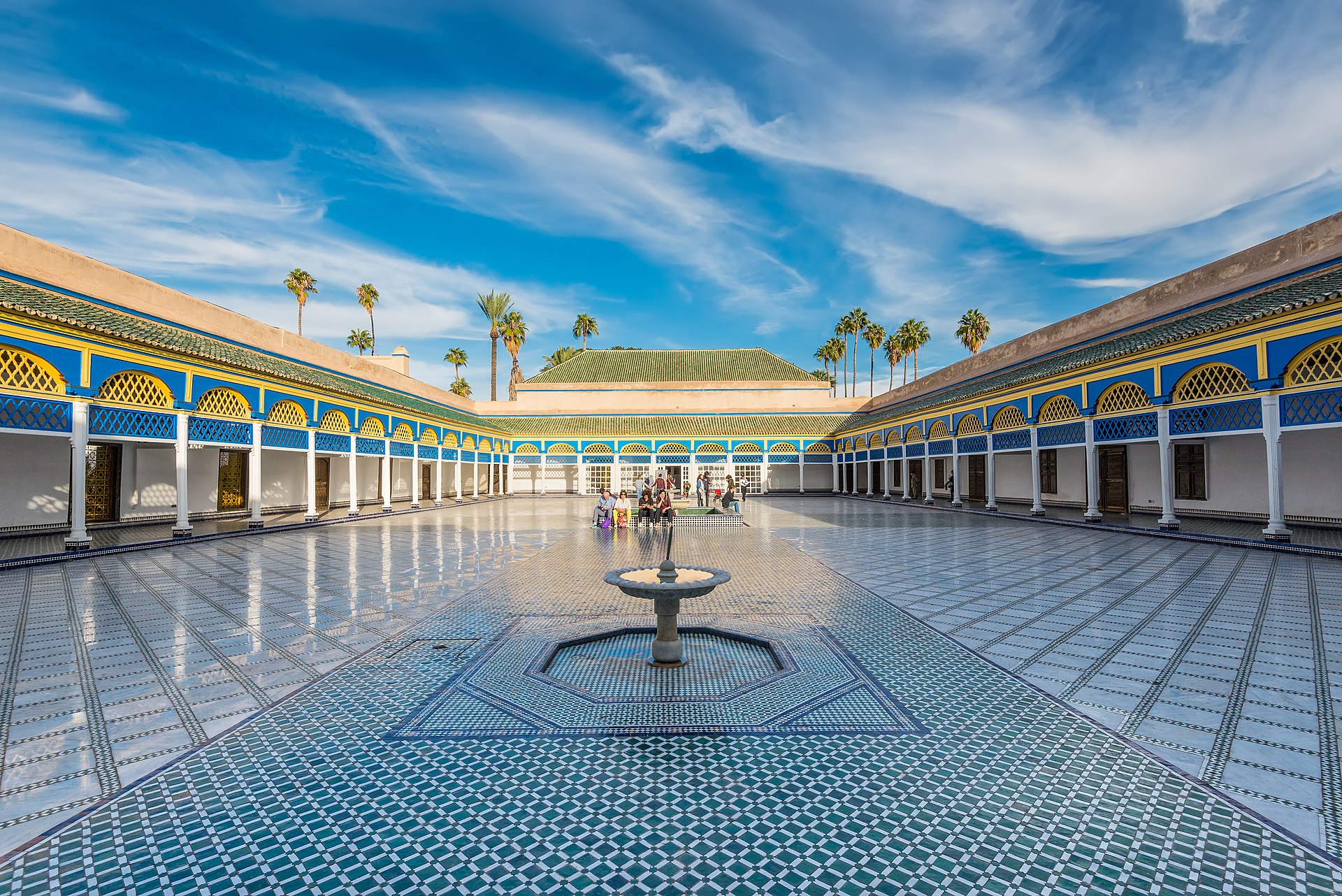
The Bahia Palace is the finest example of Moroccan palatial architecture open to visitors — a 19th-century palace built over 14 years (1866-1900) for Si Moussa, the grand vizier of Sultan Hassan I, and later expanded by his son Bou Ahmed, who intended it to be the greatest palace ever built in Morocco. The name Bahia means 'brilliance,' and the palace delivers: carved cedar ceilings, zellige (geometric mosaic tilework) in every colour, stucco carved with arabesques and Quranic calligraphy, and painted wooden ceilings that represent the peak of Moroccan decorative arts.
The palace covers 8,000 square metres and is organised around a series of courtyards — the largest open to the sky, paved in marble, and planted with fruit trees. The rooms opening onto each courtyard served different functions: reception halls, private apartments for the vizier's four wives and 24 concubines, a harem (the private quarters, not the Western misinterpretation of the word), and servants' quarters. The scale of the establishment — Bou Ahmed employed hundreds of craftsmen for over a decade — reflects the power of the Moroccan grand viziers, who in the late 19th century often wielded more influence than the sultan.
The palace was partially looted after Bou Ahmed's death in 1900 (the sultan's court stripped it of furnishings), and the bare rooms, while architecturally magnificent, lack the furnishings that would complete the picture. French general Hubert Lyautey used the palace as his residence during the Protectorate period, and parts are still used by the Moroccan royal family. The palace is open daily, and visiting in the morning (before the tour groups arrive) allows you to appreciate the craftsmanship without crowds.
Verified Facts
Bahia Palace was built between 1866 and 1900
The palace covers approximately 8,000 square metres
General Lyautey used the palace as his residence during the French Protectorate
The palace was partially looted after Grand Vizier Bou Ahmed's death in 1900
Get walking directions
Rue Imam Al Ghazali, Marrakesh, 40008, Morocco