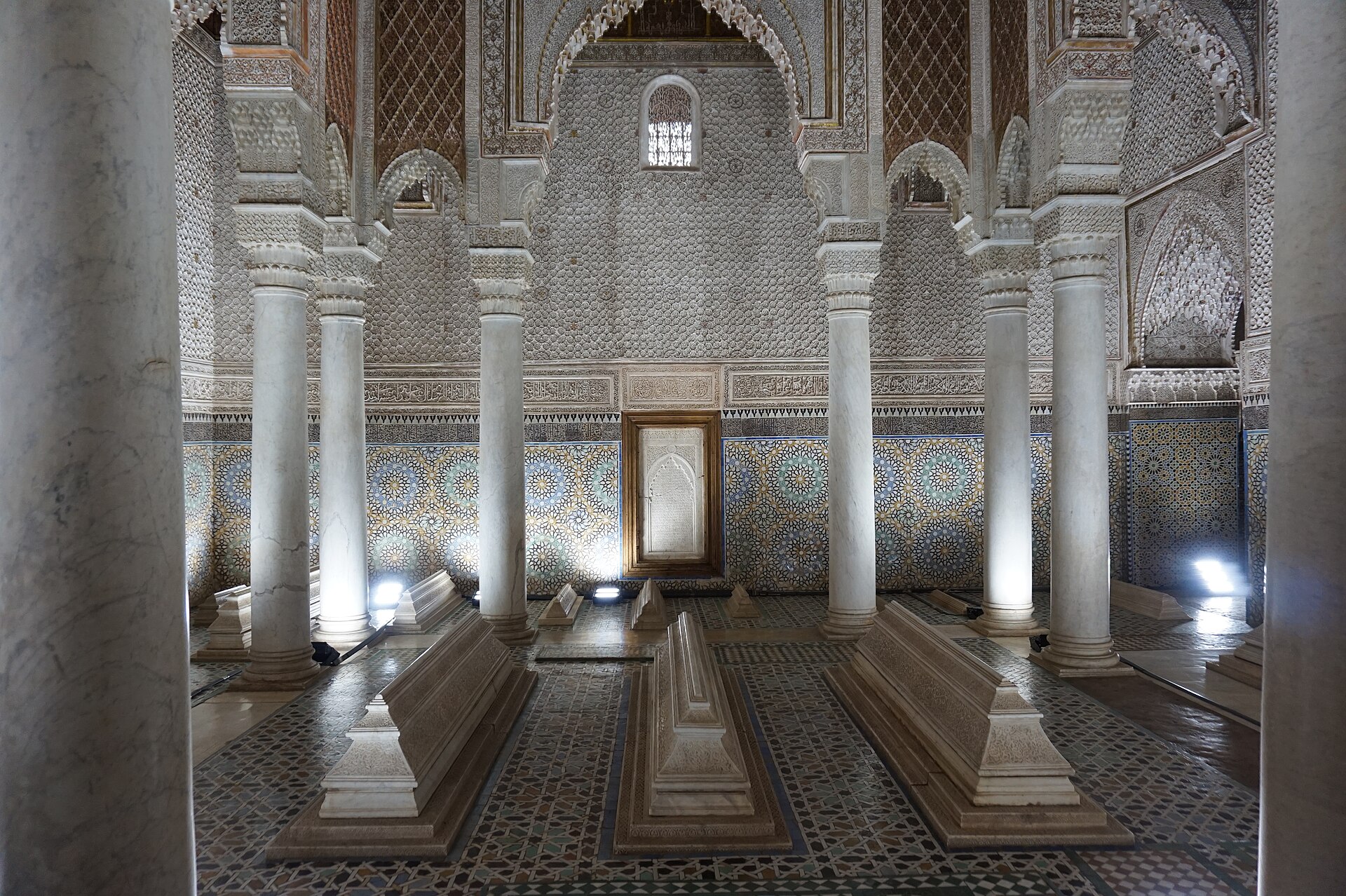
The Saadian Tombs are the most exquisite funerary architecture in Morocco — a 16th-century royal mausoleum complex that was sealed and forgotten for centuries until the French discovered it during an aerial survey in 1917. The tombs date to the reign of Sultan Ahmad al-Mansur (1578-1603), who built the Hall of Twelve Columns as his own mausoleum using Italian Carrara marble, carved cedar, gold leaf, and the finest zellige tilework that Moroccan craftsmen could produce.
The Hall of Twelve Columns is the centrepiece — a chamber of 12 marble columns supporting a carved cedar dome, with the sultan's tomb at the centre and the tombs of his family members surrounding it. The craftsmanship is extraordinary: the muqarnas (honeycomb vaulting) above the tomb is carved from cedar and gilded, the marble columns were imported from Italy at enormous expense, and the zellige tilework on the lower walls uses patterns so precise that the geometric perfection was understood as a reflection of divine order.
The tombs were sealed by the Alaouite dynasty (which overthrew the Saadians in the 17th century) to prevent them from becoming a pilgrimage site that might legitimise the rival dynasty's claim to power. The sealing preserved the tombs from the weather, looting, and the general entropy that has damaged so many Moroccan historical sites. The narrow passage through which visitors enter — the only access the French left open — creates a dramatic transition from the dusty kasbah streets to the cool, tiled splendour of the mausoleums.
Verified Facts
The Saadian Tombs date to the reign of Sultan Ahmad al-Mansur (1578-1603)
The tombs were sealed by the Alaouite dynasty and rediscovered in 1917
The Hall of Twelve Columns uses Italian Carrara marble
Muqarnas is the name for honeycomb-style vaulting in Islamic architecture
Get walking directions
Rue de la Kasbah, Marrakesh, 40040, Morocco