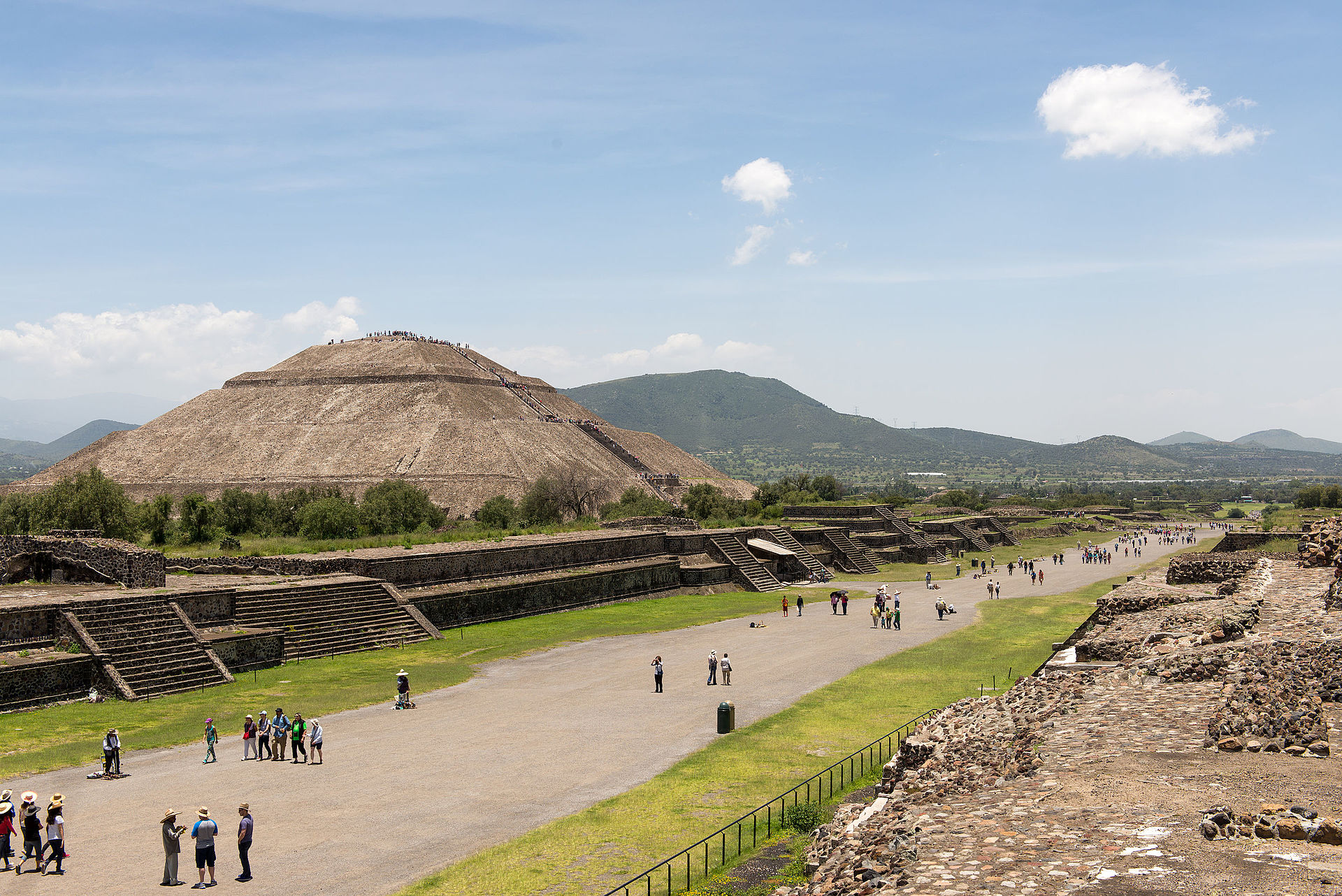
Teotihuacán is the largest and most impressive pre-Hispanic archaeological site in the Americas — a ruined city of pyramids, temples, and avenues that was home to over 100,000 people at its peak around 450 AD, making it one of the largest cities in the world at the time. The Pyramid of the Sun (the third-largest pyramid in the world by volume) and the Pyramid of the Moon dominate a 2-kilometre processional avenue called the Street of the Dead, and the scale of the ruins — visible from the top of either pyramid — is genuinely overwhelming.
The most remarkable thing about Teotihuacán is that nobody knows who built it. The Aztecs, who arrived in the Valley of Mexico centuries after Teotihuacán's collapse around 550 AD, found the ruins already abandoned and believed they had been built by giants or gods (the name 'Teotihuacán' is Nahuatl for 'the place where the gods were created'). Modern archaeology has revealed an extraordinarily sophisticated urban civilisation — multi-storey apartment compounds, a sophisticated water management system, and evidence of trade networks spanning Mesoamerica — but the builders' name for themselves and their language remain unknown.
The site is about 50 kilometres northeast of Mexico City (about an hour by car or bus from the Terminal Norte bus station). Climbing the Pyramid of the Sun — 248 steps to the summit — is physically demanding but the view from the top, looking down the Street of the Dead toward the Pyramid of the Moon with the Valley of Mexico stretching to the horizon, is one of the most extraordinary perspectives in the Americas. Go early to beat the heat and the tour buses.
Verified Facts
Teotihuacán had a population of over 100,000 at its peak around 450 AD
The Pyramid of the Sun is the third-largest pyramid by volume in the world
The builders' identity and language remain unknown
Teotihuacán means 'the place where the gods were created' in Nahuatl
Get walking directions
Calle Teotihuacán, Hipódromo, Cuauhtémoc, 06100, Mexico